
...
This page pertains to ONLY Vermont and pilot programs using ADAM for their assessment management system and ChromeOS devices to deliver tests.
- ADAM users using web extensions (Co:Writer or Read&Write) must use the TN app. See Set Up TestNav on ADAM and ChromeOS - TN App Setup.
- ADAM users testing without web extensions can use either the TestNav PWA or the TN app for testing.
Progressive web apps (PWAs) are web applications that use progressive enhancements. Users can open PWAs from the user’s home screen. PWAs run in a standalone window, and users see the same TestNav user interface (UI).
| Tip | ||
|---|---|---|
| ||
During BOTH the infrastructure trial and the actual test, note Note which specific device each student uses during each test. The TestNav app saves SRFs to only one designated place on the testing device. If an error occurs, you can locate files only on that specific device. |
Pearson supports only managed Chromebooks for secure testing. Both before you install TestNav AND prior to each testing session, you should check each device to ensure it is in managed status. Anchor managed1 managed1
| Digi Accordion | ||||||||
|---|---|---|---|---|---|---|---|---|
| ||||||||
|
Install TestNav PWA
To install TestNav PWA , first ensure each device's settings are set to keep local data to avoid accidentally deleting the SRF and log files. Then, you add TestNav as a kiosk app.
...
- Sign in to the Google Admin console for your domain, using your administrator account (does not end in @gmail.com).
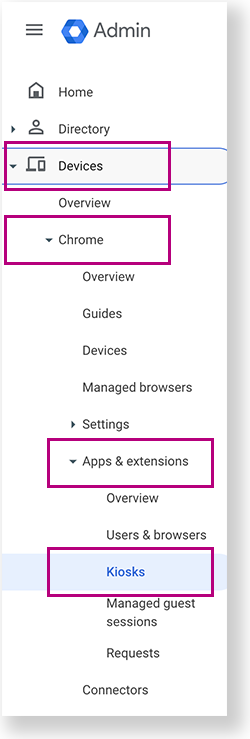
From the Google Admin console home page, go to Devices > Chrome >Apps & extensions >Kiosks.
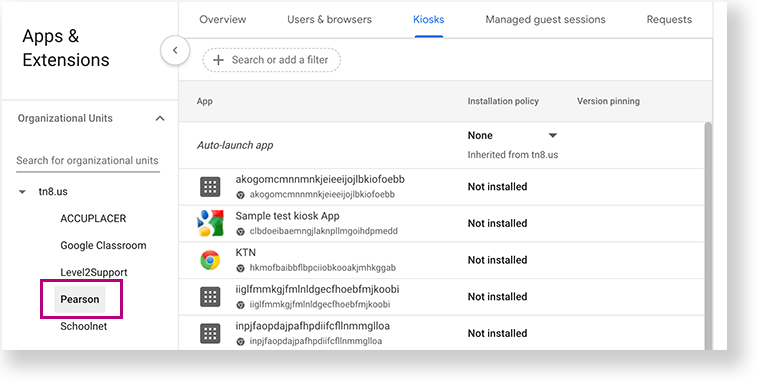
- Under Organizational Units, select the top-level organization that you want to apply these settings to. Then, select a child organization, if necessary. In the example below, Pearson is selected to give all Chromebooks within the Pearson organization access to TestNav.
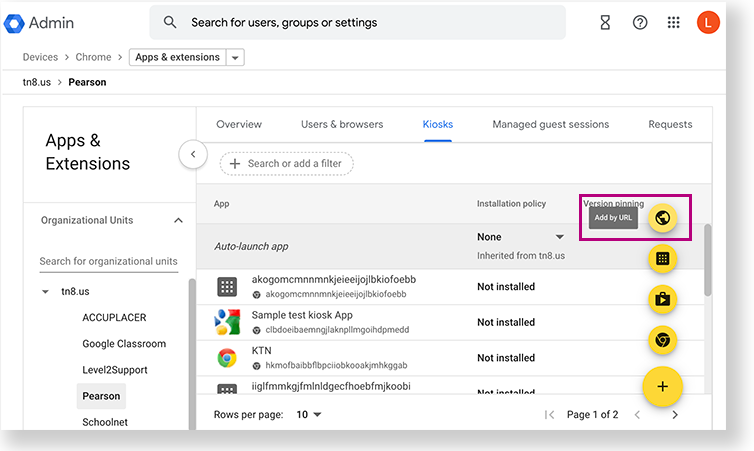
- Click the Add by URL icon.
- Add the following URL:home.testnav.com#:standalone:
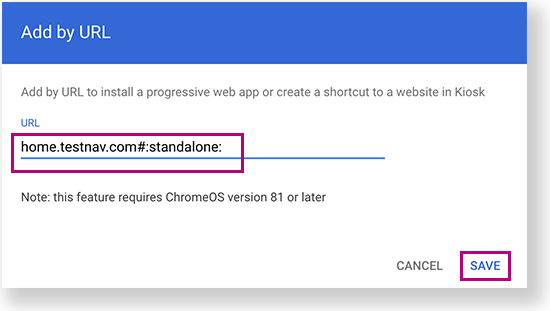
- Click Save.
Chrome displays the message, Note: Adding Web Apps in Kiosk. Select Agree.
- Click Save again.
| Info | ||
|---|---|---|
| ||
Students with accommodations or accessibility features enabled through their PNP or test form access those features within TestNav. ChromeOS has native accessibility features that might appear within a kiosk floating accessibility menu during testing. Technology personnel can disable this menu before testing to avoid it interfering with the student’s test. |
Anchor launch launch
Sign in to TestNav
| launch | |
| launch |
- Power on the device, but do not log in. If before a secure testing session, check the device's managed status.
- In the lower left of the screen, select Apps >
 Home - TestNav to launch the TestNav PWA.
 If you have not already done so, choose the appropriate icon for your test on the home page. If your test was selected before the test session, you see the Sign In page, rather than the home page.
If you need to select a different test, click the user dropdown menu at the upper-right of the page, and click Choose a different customer.
Include Page IR:_TN_graphic_chooseCustomer IR:_TN_graphic_chooseCustomer Click the appropriate icon for your test.
Include Page IR:_TN_graphic_installHome IR:_TN_graphic_installHome
- Start a test to ensure that you can do so without error, using ADAM test card credentials.
- To shut down and exit kiosk mode after the app launches, hold down the button.
...
- Open the TestNav PWA app from TestNav - Home.
- Focus your cursor in the username or password field.
- Press <ctrl><shft>z, and the File Viewer box appears.
If the File Viewer does not display, click on the window and then press <ctrl><shft>z again. - Plug in a USB memory stick.
- Click the download button next to the srf and log file(s) you want to download.
- When the window opens, select the USB memory stick, and click Save.
...
Include Page IR:_TN_SRFandLogsRelatedInfoInstall IR:_TN_SRFandLogsRelatedInfoInstall
...